Refurbished and second-hand Apple Watch: complete buying and selling guide
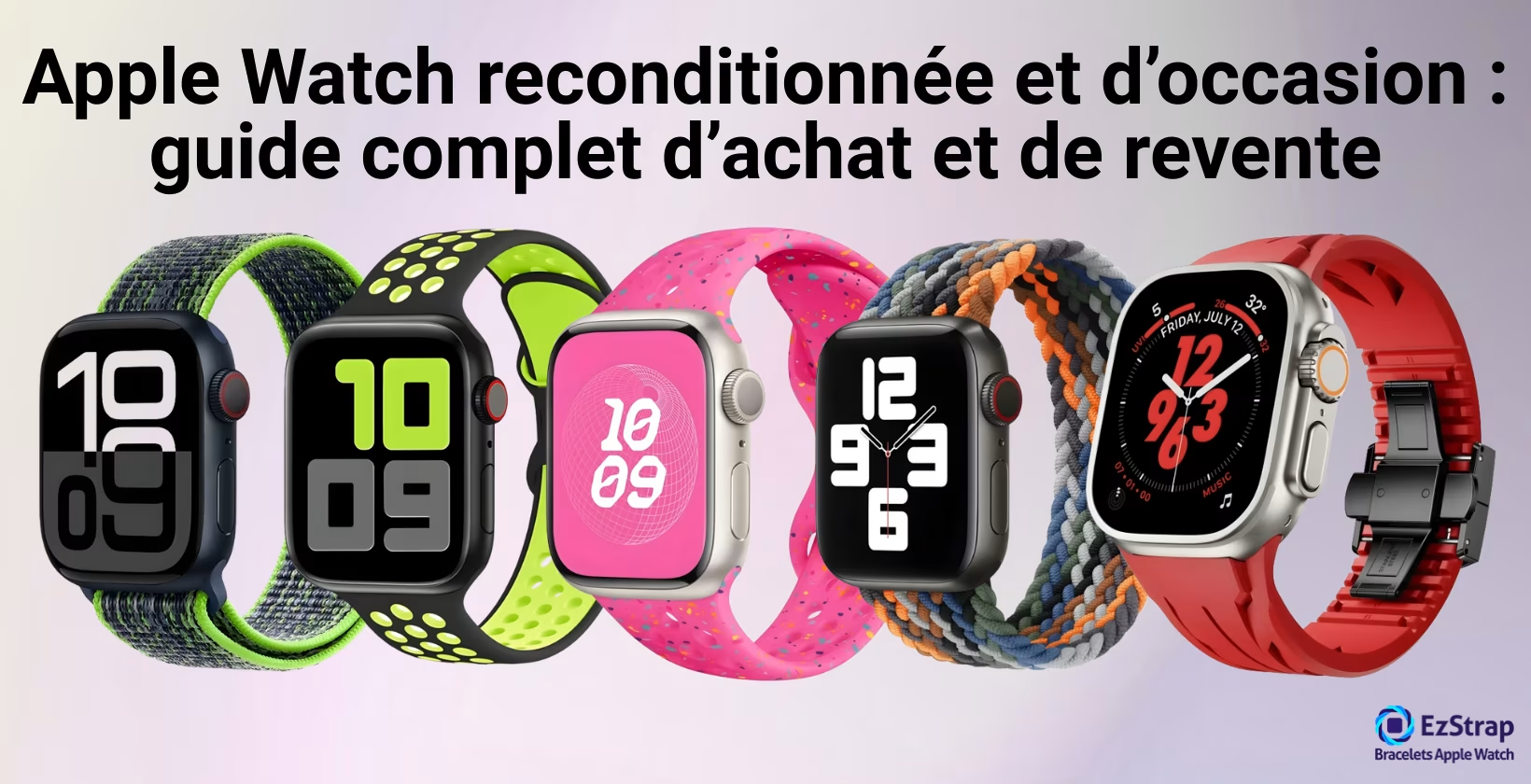
A second-hand Apple Watch is an Apple Watch that is put back on sale after being used by one or more previous users. It may be sold on various unregulated platforms (marketplaces, classified ads) as it is, with no inspection or certification other than the manufacturer's original warranty (if it still applies).
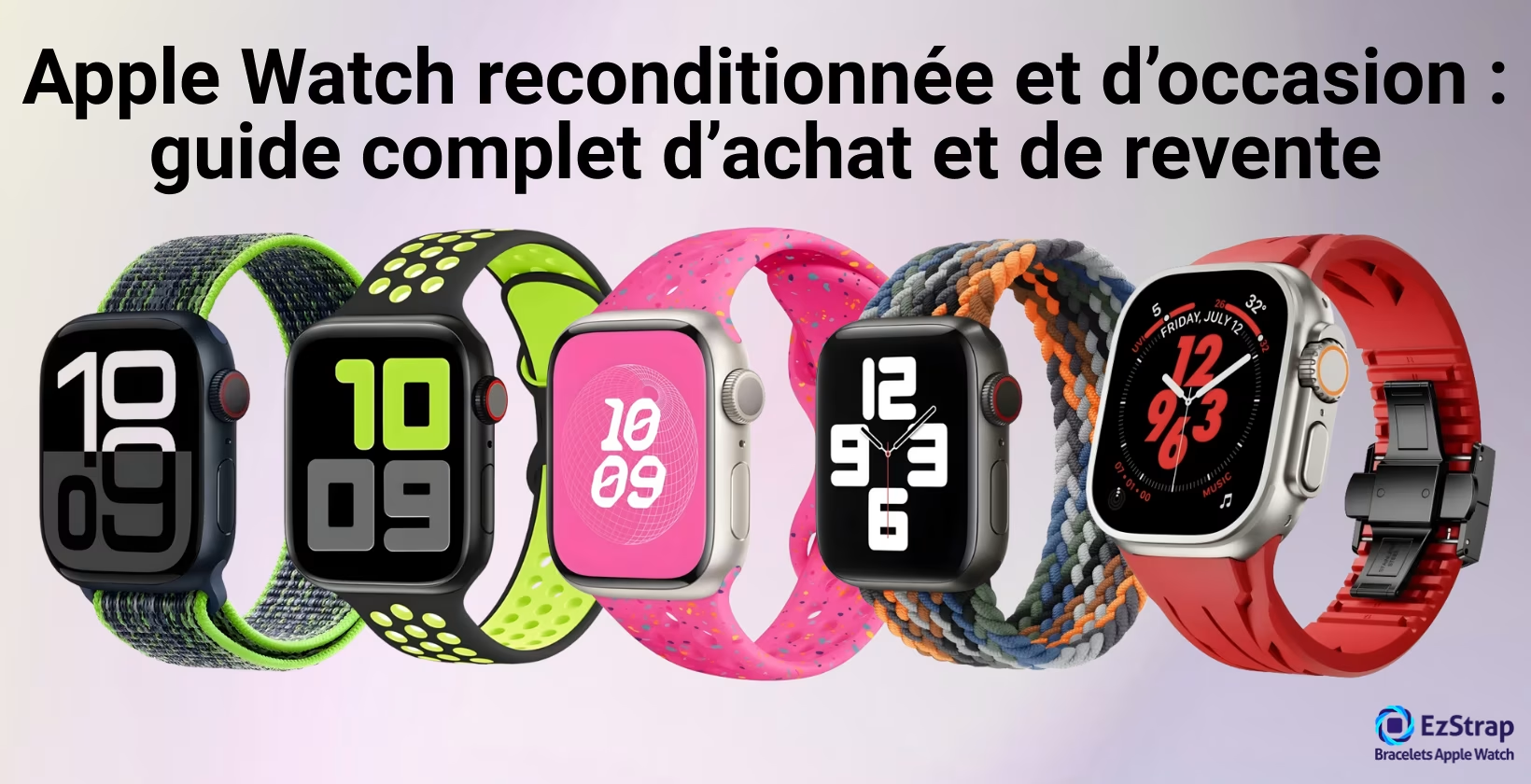
A refurbished Apple Watch is a second-hand Apple Watch that has been restored to optimal working order by certified professionals according to controlled quality criteria. Restoring the Apple Watch during the refurbishment process first involves an exhaustive technical inspection of the components (battery, case, waterproof seals, Digital Crown, screen, buttons, etc.), then replacing any faulty or worn components. Once the components have been replaced, the Apple Watch is tested again, then offered for sale on specialist platforms.
This guide compares the advantages of refurbished over second-hand and gives price ranges by model to help you size up a listing or a trade-in — for a firm valuation of your watch, use the trade-in platforms listed further down (SimplyUsed, Recommerce). Refurbishment grades are explained, along with the models to favour and to avoid in 2025. You will find the main platforms specialising in buying and selling refurbished and second-hand Apple Watches, along with the checks to make on receipt.
In short: the best balance of safety and price is a refurbished Series 9 (€250-400) from a certified refurbisher such as Back Market or Largo. Buying second-hand from a private individual costs 15-25% less, but should only be attempted after the 6-point check (battery, iCloud lock, serial number…).
Jump straight to: refurbished or second-hand? · the 6-point check · which model to choose
What is the difference between a refurbished Apple Watch and a second-hand Apple Watch?
A refurbished Watch differs from a second-hand Watch in several ways, notably price, warranty and quality. Here are the main differences to know before you buy.
-
Price: A refurbished Apple Watch costs around 15 to 25% more than a second-hand watch with the same specifications. This is justified by the costs of refurbishment, quality control and certification. For example, a second-hand Series 8 is worth €200-250, whereas the same watch refurbished costs €280-320.
-
Warranty: Refurbished Apple Watch: 12 to 24-month commercial warranty depending on the professional seller. Second-hand Apple Watch: No warranty between private individuals, except the 6-month legal guarantee of conformity if bought from a professional.
-
Cosmetic condition: Refurbished Apple Watch: Appearance checked and graded (A, B, C). Scratches and dents repaired or disclosed. Second-hand Apple Watch: Wear from the previous owner, unchecked and with no standardisation.
-
Technical check: A refurbished Apple Watch is tested across all its functions (screen, sensors, battery, water resistance, connectivity). This is not the case for a second-hand Apple Watch, which therefore increases the risk that some components do not work properly.
-
Accessories included: A refurbished Apple Watch is sold with its band, charging cable and documentation in standardised packaging. A second-hand Apple Watch may be sold bare or with worn-out accessories.
-
Traceability: The refurbished Apple Watch has a traced history with a verified serial number and a verified stolen status. The second-hand Apple Watch has no traced history, with manual verification of its status and provenance.
In short, a refurbished and a second-hand Apple Watch come with different guarantees. The choice depends on your budget and your tolerance for risk: pay a little more for the security of refurbished or save more with the uncertainty of second-hand.
What are the risks of buying a refurbished Apple Watch?
Buying a refurbished Apple Watch carries certain risks, particularly when you don't know where the parts used come from. These risks can compromise the functionality, durability and user experience of your smartwatch.
-
Risk of receiving counterfeit parts: Some refurbishers use poor-quality unofficial parts to repair watches. These counterfeit screens, batteries or sensors crack, lose their water resistance or start to fail after a few weeks of use. There are many documented cases of screens that break without any impact and of watches that split open because of faulty parts.
-
Compromised water resistance: A refurbished Apple Watch often loses its original water resistance if the refurbishment was not done properly. It is common to read accounts of watches that failed after a simple shower or contact with water, even though they are supposed to withstand depths of up to 50 metres according to Apple's specifications.
-
No warranty on battery degradation: Most retailers do not include battery life in their warranty. Some refurbishers have also been seen replacing the remaining original batteries with uncertified ones, resulting in reduced lifespan, unstable charging and even power-management malfunctions.
-
Misgrading: Sellers don't hesitate to misrepresent the real condition of the watch, making you pay the price of a new one for an "as new" product when you actually receive a device of a lower grade with visible scratches, dents or signs of wear. This deceptive practice directly harms the value for money of your purchase.
-
Loss of official Apple support: An Apple Watch refurbished to as-new condition by a third-party refurbisher loses its eligibility for Apple technical support and official repair services. If a complex problem arises, you have to rely on the refurbisher, who may not have the skills or parts needed for a quality repair.
-
Missing or non-working parts: Some refurbished watches have disabled sensors, missing connectors or restricted features. For example, there are versions where the Force Touch sensor was removed without replacement, affecting the UX even though the software feature no longer exists. This type of risk can be minimised by buying from accredited retailers, opting for "as new" grades and using trial periods to check every feature before the cooling-off period expires.
It is therefore essential to find out about the origin of the parts and the seller's reputation before investing in a refurbished Apple Watch.
What are the risks of buying a second-hand Apple Watch?
Buying a second-hand Apple Watch from a private individual means taking many risks, which can turn a good deal into a genuine financial trap. These dangers concern both the functionality and the safety of your future purchase.
Buying a refurbished Apple Watch without a serious warranty exposes you to multiple risks that can turn this apparent saving into a nasty surprise. These risks affect both the reliability and the lifespan of your smartwatch.
-
No warranty: A second-hand Apple Watch sold between private individuals comes with no commercial warranty. In the event of a breakdown, malfunction or any other problem, you have no recourse against the seller. You are exposed to repair costs that can quickly exceed the initial purchase price of the watch.
-
Watch locked by the previous owner: The most serious risk is receiving an Apple Watch that is still linked to its previous owner's iCloud account. In that case, the watch is completely unusable, because it asks for the former user's Apple credentials to be unlocked. Apple cannot unlock these devices, even with proof of purchase.
-
Real condition hidden by the seller: A private seller may deliberately conceal significant defects: a micro-cracked screen, faulty sensors, sticking buttons, connectivity problems. Without being able to test the Apple Watch thoroughly at the time of purchase, these hidden defects only appear after daily use.
-
Undisclosed battery degradation: The battery of a second-hand Apple Watch can be badly degraded without this being visible at first glance. Battery life reduced by several hours compared with the original specifications is a major handicap day to day, but this problem is only detected after several days of use.
-
Compromised but invisible water resistance: An Apple Watch that has suffered knocks or DIY repairs may no longer be IP68 water-resistant without showing any visible damage. This hidden defect only reveals itself on contact with water, risking irreversibly ruining the watch as early as a shower.
-
Stolen or insured Apple Watch: Buying a stolen Apple Watch exposes you to prosecution and seizure by the police. Some watches are also covered by an active insurance contract, leading to legal complications with insurers if a claim is declared.
-
Missing or counterfeit accessories: The seller often fails to mention the absence of essential accessories (magnetic charging cable, original band, documentation) or, worse, supplies counterfeit accessories that can damage the watch during charging.
-
No traceability or history: There is no way to trace the real usage history (exposure to moisture, knocks suffered, amateur repairs, storage conditions…). This opacity makes it impossible to assess the remaining lifespan of the device and the risk of premature failure.
Ultimately, while buying second-hand looks financially attractive, these combined risks make the good deal a gamble. It is better to favour secure channels with at least a minimum warranty.
What do refurbishment grades mean?
The refurbishment grade is a cosmetic rating that tells you the visual condition of a refurbished device, with no bearing on its performance. According to the Fnac-Darty group, this rating "says nothing about technical reliability and longevity but informs the consumer about visible signs of wear".
Since the decree of 17 February 2022 regulating refurbished goods, a product bearing the "refurbished" label has been subjected to rigorous safety and usage tests to meet legal requirements.
| Grade | Description |
|---|---|
| Grade A+ (Perfect condition) | Device showing no signs of wear, visual appearance identical to a new product. This is the highest grade in refurbishment, where the Apple Watch keeps its original appearance after a complete refurbishment. |
| Grade A (Very good condition) | Presence of very slight signs of wear (barely visible micro-scratches). These cosmetic flaws do not affect functionality and are barely noticeable in use. |
| Grade B (Good condition) | Visible signs of wear (scratches on the edge, the case or a few scuffs). Despite the marks of wear, the device is 100% functional after the refurbishment checks. |
| Grade C (Fair condition) | Very visible signs of use with major scratches, scuffs or impacts on the screen and the body. This grade covers Apple Watches whose appearance is heavily degraded but which passed all of the technical tests for proper operation. |
Some merchants prefer alternative names: "Excellent", "Premium", "Shiny" or "ECO grade". These variations in terminology follow the same cosmetic classification logic, each device having to be 100% operational whatever its grade.
Which refurbished or second-hand Apple Watch should you choose?
Choosing a refurbished or second-hand Apple Watch model comes down to three criteria: the available budget, the features you are looking for and the expected lifespan. This selection lets you optimise your purchase by targeting the models with the best value for money.
-
Apple Watch Series 9 (2023) – The ideal balance
The reference model for most users, with a great balance of performance and price.
Refurbished price: €250-400 depending on condition and size.
Pros: S9 chip, Always-On display, ECG & SpO2, watchOS until 2029 at the very least. Double Tap & Crash Detection.
Con: Thicker design than the Series 10, no Action Button. -
Apple Watch Ultra 2 (2023) – For demanding athletes
The absolute reference for outdoor use and battery life.
Refurbished price: €650-850 depending on grade
Pros: 36h battery life, 49mm titanium case, 2000-nit display, 100m water resistance, dual-frequency GPS, programmable Action button. Full sports sensors, military-grade toughness.
Cons: Very bulky, expensive even refurbished, masculine look. -
Apple Watch SE 2 (2022) – The good entry-level compromise
A cheaper option that keeps the essentials.
Refurbished price: €180-280 depending on size.
Pros: Fast S8 chip, Crash Detection, full notifications, basic fitness tracking, contemporary look. Good value for money for taking your first steps into the Apple ecosystem.
Cons: No Always-On display, no ECG or SpO2, 2nd-generation heart-rate sensor less accurate. -
Apple Watch Series 8 (2022) – The more recent alternative
Mid-range model with a full set of health sensors.
Refurbished price: €300 to €450 depending on condition.
Strengths: Skin temperature sensor, advanced menstrual cycle tracking, ECG & SpO2, Always-On display, proven Series 7 design. Software longevity assured for several more years.
Weaknesses: Less powerful than the Series 9, no Double Tap, thicker body.
Warning: It is inadvisable to turn to models from before 2022 (Series 6 and earlier), which are reaching the end of the road because they suffer from major technical limitations: poor battery life, lagging performance and the imminent end of watchOS support.
If your budget allows, you can go for a new Apple Watch. In that case, feel free to read our guide to choosing the Apple Watch best suited to your needs.
Which older models should you avoid buying in 2025?
Some Apple Watch models now suffer from critical technical and software limitations, so buying them is not recommended in 2025. This list covers the generations that are obsolete or about to become so, at risk of incompatibility, sluggishness and no support.
-
Apple Watch Series 4 (2018) – End of support confirmed
First generation excluded from watchOS 11 as of September 2024. Second-hand value: €80-150.
Deal-breaking drawbacks: lasting exclusion from new features, end of security patches, S4 chip running out of steam on modern apps. Official vintage status since January 2025.
Only remaining positive: Modern design with a larger screen than previous generations. -
Apple Watch Series 5 (2019) – Updates not supported
Model also deprived of watchOS 11 despite being only 5 years old. Second-hand value: €100-180.
Deal-breaking problems: No updates, poor battery life because of the first-generation Always-On display, unable to use recent apps requiring watchOS 11. S5 chip too slow for 2025 usage. -
Apple Watch SE 1st generation (2020) – No longer supported
Premature end of support after only 4 years, proof of Apple's planned obsolescence. Second-hand price: €120-200.
Deal-breaking shortcomings: Deprived of watchOS 11, no always-on display, 1st-generation heart-rate sensor less accurate, lagging S5 performance.
This short lifespan makes it a risky bet even at a low price. -
Apple Watch Series 1, 2 and 3 (2016-2017) – Totally obsolete
Historic older generations that are now completely unusable with recent iPhones. Second-hand value: €40-80.
Unusable: Cannot be paired with iOS 16+, support stopped since 2020-2021, third-party apps not working, battery dead after 7-8 years.
With an official "obsolete" status and Apple repairs discontinued, these models have no use whatsoever in 2025.
Since these Apple Watch models are obsolete, it makes more sense not to buy them. Prefer more recent models so as not to risk ending up with an Apple Watch that doesn't work or that lacks access to modern health, fitness and connectivity features.
What are the sites for buying and selling refurbished Apple Watches?
Here are the main platforms in France for buying or selling a refurbished Apple Watch.
-
Back Market
The French leader in refurbished, with more than 50% savings on recent models. A marketplace connecting customers with hundreds of certified refurbishers, with a warranty of up to 12 months and interest-free payment in 4 instalments. -
Certideal
Key player specialising in high-tech refurbishment with a 24-month warranty. Direct competitor to Back Market with a more rigorous selection of its refurbisher partners. -
Rebuy
Well-established European platform guaranteeing refurbished Apple Watches for 3 years. Structured service (140.8K visits/month) with a quality-focused approach to refurbishment. -
Largo
Independent French refurbisher based near Nantes. 37 check points. 24-month warranty. 21 days to try it. Guaranteed battery capacity of over 85%. -
Smaaart
French manufacturer. Refurbished in our factory in Montpellier. Warranty of up to 24 months. Supplies come from French private and business flows. 15-day money-back guarantee. -
OUI
French workshop based in Caen championing "made in France", with a 2-year warranty. Aim of opening workshop-shops across France to be close to customers. -
iServices
French platform with an extended 3-year warranty, with charger and band included. Stands out with a longer warranty than the others. -
Fnac/Darty
General retailers selling refurbished Apple Watches on their marketplaces. They benefit from their after-sales service 7 days a week and in-store collection services, with payment in 24 instalments. -
Amazon Refurbished
Amazon category with a 12-month warranty and 14-day returns. Huge choice with Prime delivery and easy payment. -
Recommerce
French pioneer subcontracting to French workshops (Gentilly, Lieusaint, Toulouse, Vitré). Resells through Bouygues Telecom, Auchan and under its own brand Re!.
What are the sites for buying and selling second-hand Apple Watches?
Here are the main platforms in France for buying or selling a second-hand Apple Watch.
-
leboncoin
French leader in classified ads with more than 10,000 second-hand Apple Watch listings. Attractive prices from €80 to €800 depending on the model. Direct payment between private individuals and the possibility of testing before buying. -
Rakuten (formerly PriceMinister)
Japanese marketplace allowing individuals to sell easily, with buyer protection and a loyalty points system. Offers Apple Watches from €280, with the possibility of negotiating directly with sellers. -
Vinted
Second-hand platform with an electronic verification offer via a control centre. Secure payment and buyer protection, ideal for Apple Watch accessories and bands. -
eBay France
International auction site with a wide choice of second-hand Apple Watches from €66 to €800. PayPal protection, auctions or buy-it-now, private and professional sellers. -
Facebook Marketplace
Social platform for buying between private individuals with verified profiles. Second-hand items at competitive prices and the chance to see the product before buying, including recent models such as the Ultra 2. -
Cash Converters
Chain of second-hand shops with Apple Watches tested and guaranteed for 1 year. Up to 50% savings on the price of new, with fast delivery and quality checked in store. -
Easy Cash
French store network selling refurbished Apple Watches with a 2-year warranty. The products come from the stock of the physical stores. 100% secure payment. -
Mac Avenue
Verified second-hand Apple Watches at low prices from a second-hand Apple specialist. Benefits from Apple technical know-how. Limited stock and checked products. -
SimplyUsed
Buys or sells Apple Watches at the best price. Automatic valuation and immediate payment. Even buys broken ones. Valuation in line with the current second-hand price. -
Darty Second-Hand
A second-hand service from the retailer with an after-sales service reachable 7 days a week. Possibility of trading in your device. In-store collection in 1 hour subject to stock, free home delivery.
These platforms offer a variety of options for finding the watch that suits your budget, with different levels of warranty and intermediaries. Each site has its own particularities, so remember to compare before buying.
What should you check before buying a refurbished Apple Watch?
Buying a refurbished Apple Watch requires choosing the reseller wisely and checking the refurbishment processes applied. Specific checks make it possible to ensure that the device has undergone a professional refurbishment and delivers the same performance as a new model, with transparency about the repairs carried out and the warranties granted.
1. The refurbishment level (as new, very good condition, good condition).
The refurbishment level refers to the cosmetic classification that defines the cosmetic condition of the refurbished Apple Watch according to standardised grades (A+, A, B, C), indicating the degree of visible signs of wear without any impact on the functional performance of the device.
- Grade A+ corresponds to a device with no visible signs of wear, looking as new.
- Grade A shows slight micro-marks of use that are barely visible.
- Grade B shows visible signs of wear such as scratches on the edge or the case.
- Grade C has very visible signs of wear with scratches, scuffs or impacts.
Since the decree of 17 February 2022, the terms "as new", "in new condition" or "like new" are no longer permitted, so as not to suggest a new product.
Check that the stated condition matches the visual condition of the device by asking for detail photos if the purchase is made remotely. The presence of light micro-scratches or visible signs of use does not call into question other aspects such as functionality or structural strength.
Remember that a lower cosmetic grade does not compromise the operation of the device.
2. The length and terms of the warranty.
The length and terms of the warranty are the reseller's contractual commitments regarding the extent of coverage for technical defects, the length of protection and how a malfunction of the refurbished Apple Watch is handled.
Key points to check:
- Demand a warranty of at least 12 months for a professionally refurbished device; some resellers even offer 24 months, like Largo.
- Check the coverage of critical components: battery, screen, health sensors, Bluetooth/Wi-Fi connectivity.
- Make sure the conditions exclude only accidental damage (drops, immersion) and not the normal wear of components.
Also, ask whether the warranty provides for replacement or only repair and what the turnaround times are (72 hours in general). Check that the warranty starts on receipt and not at purchase, and whether it is transferable if you resell. Apple provides its own one-year warranty on its official refurbished products, but third-party resellers often have better terms.
3. The returns and exchange policy in case of a problem.
The returns and exchange policy corresponds to the contractual provisions setting the conditions for returning or exchanging the refurbished Apple Watch in case of a defect, dissatisfaction or non-conformity, notably the time allowed, any fees and the practical arrangements for sending it back.
Essential points to check:
- Demand a minimum return period of 14 days in line with European distance-selling legislation, with some resellers offering 30 days or more to stand out.
- Make sure the policy covers hidden defects that are not visible on receipt, not only immediate malfunctions.
- Check that return costs are borne by the seller in the event of a proven defect, with only returns for personal convenience possibly being charged.
- Confirm the exact arrangements: sending of a prepaid return label, whether or not the original packaging is required, time to refund after the return is received.
- Make sure an exchange is possible instead of a simple refund, and whether the replacement is an identical or equivalent model.
- Check that the policy still applies if the Apple Watch shows traces of light use after a trial, a normal state for product testing.
4. The accessories included (official or compatible charger, band, box)
The accessories provided refer to the items that come with the refurbished Apple Watch, such as the magnetic charging cable, the band and the packaging, which are expected in order to guarantee the completeness of the product and the user experience.
Key items to check:
- The presence of the official Apple magnetic charging cable or an MFi-certified equivalent (Made for iPhone/iPad), recognisable by its circular magnetic connector and its quality finish.
- The condition and authenticity of the band supplied, matching the size ordered (38/40/41 mm and 42 mm on Series 10 and 11, or 42 mm on Series 1 to 3 and 44/45/46 mm, depending on the version) and with no deformed or damaged lugs.
Also ask about the presence of the original packaging, which guarantees authenticity, simplifies a return and adds resale value. Check that retailers systematically include new or excellent-condition accessories, as Largo and iServices do in their listings. As Apple has not supplied a power adapter since the Series 6, only the cable comes with official refurbished boxed sets.
The 6-point check before buying
In front of the seller, phone in hand: run through these six checks one by one before paying, and the checklist gives you the verdict.
What should you check before buying a second-hand Apple Watch?
Has the second-hand Apple Watch you are buying been checked against these six points? Buying a second-hand Apple Watch exposes you to risks such as: counterfeits, hidden faults, locked devices. These six crucial checks make your purchase safer, ensuring you acquire a working, genuine device while avoiding the pitfalls of the second-hand market.
1. Battery health
Battery health is the maximum capacity percentage the battery retains compared with its original capacity, and it lets you judge how degraded the battery is and how much life it has left. The check is carried out directly on the Apple Watch in Settings > Battery > Battery Health, with a percentage showing current capacity compared with when it was new.
Practical tips & things to check:
- A percentage above 85% is required for a decent purchase, with 80% being the critical threshold at which, according to Apple, a replacement is needed.
- Have the seller carry out this check live in front of you, or at the very least send them an authenticated screenshot.
- Avoid any device with less than 75% capacity: battery life will then be dramatically affected, with several charges a day unavoidable.
- Also look at the usage graph in the same menu, which lets you gauge recent charging habits and spot any inconsistencies in consumption.
Why is this figure so crucial? A worn-out battery can mask other performance problems and completely spoil the experience.
2. Water resistance condition
Like a watertight seal, water resistance reflects the Apple Watch's ability to keep water out, a crucial characteristic that can be weakened by wear, knocks or poor refurbishment. A second-hand Apple Watch may have lost this vital barrier without any external sign, exposing its internal components whenever it comes into contact with water.
Key points to check:
- Hunt for cracks and hairline cracks on the front screen and the rear glass: even when invisible to the naked eye, they instantly destroy water resistance.
- Inspect the condition of the seals around the Digital Crown and the side button, areas prone to water ingress.
- Ask the seller about past exposure to water and demand a demonstration if possible.
- Steer clear of any device refurbished by unapproved third parties, as water resistance is rarely retained once the case has been opened.
- On the Apple Watch Ultra, pay particular attention to water resistance despite their reinforced design.
3. Cosmetic condition (screen, case, band)
Cosmetic condition refers to the visual assessment of the wear marks and cosmetic defects on the Apple Watch's screen, case and band, in order to judge its residual value and to detect any knocks that might be concealing internal damage affecting how it works.
Key checkpoints:
- Examine the screen carefully from different angles and in different lighting to spot scratches, cracks or dead pixels that impair legibility and water resistance.
- Go all the way round the Apple Watch case, especially the aluminium or steel edges, which readily reveal the knocks and impacts it has suffered.
- Check the Digital Crown and the side button, which must move freely, without sticking or excessive play.
- Look at the cleanliness and integrity of the band, especially its attachment points, which are common weak spots.
- Check that the clasp mechanisms work properly.
- Pay particular attention to the sensors on the back of the watch, which must show no scratches or oxidation that could skew health and fitness measurements.
4. The authenticity and origin of the Apple Watch
Authenticity and provenance concern checking that the Apple Watch is a genuine Apple product and not a counterfeit, as well as confirming its lawful origin, so as to avoid buying a stolen device or one blocked by Activation Lock. Key items to check:
- Find the serial number engraved in the band slot or via Settings > General > About, then check it at checkcoverage.apple.com to confirm authenticity and obtain warranty information.
- Check that the device can be paired with your iPhone without showing an Activation Lock screen, a sign that the watch has not been properly unlinked from the previous Apple Account.
- Ask for the original purchase invoice or proof of lawful provenance.
- Check the build quality and compare it with Apple's official specifications: weight, dimensions, materials and features must match the model advertised.
- Beware of very low prices, which often hide a counterfeit or a problem, as Apple Watches hold a good resale value even second-hand.
5. Included accessories (cable, charger)
The accessories listed will complete what normally comes with a second-hand Apple Watch, namely the magnetic charging cable and the power adapter, which are essential for everyday use and expensive to buy separately if they are missing.
What are the important points to check?
- Check that the official Apple magnetic charging cable is present, with its round magnetic connector and premium finish.
- Test that it works straight away by connecting it to the watch to see whether it attaches properly and starts charging.
- Inspect the cable along its whole length for kinks, cuts or exposed wires that could cause malfunctions or safety hazards.
Note that Apple has no longer supplied a power adapter in the box since the Series 6, only the charging cable (see step 3).
Also check that the original packaging and the documentation are present, which prove authenticity and add value for any later resale.
If some accessories are missing, negotiate the price! Replacing the cable costs €29 at Apple, and you need to add €25 for a USB-C power adapter.